
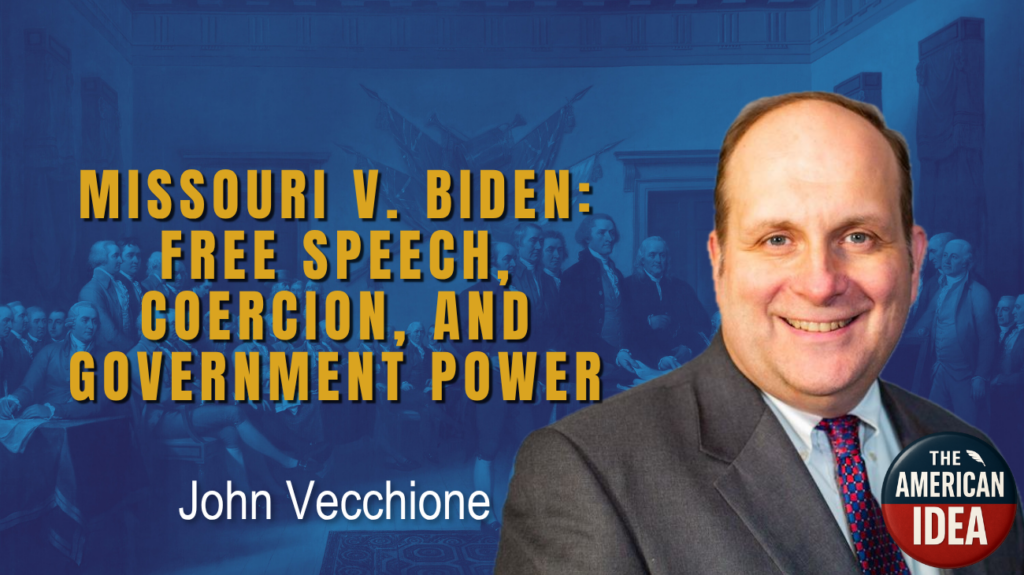
Missouri v. Biden: Free Speech, Coercion, and Government Power
April 8, 2026
Join The American Idea’s Listener Email list – get news about upcoming episodes and a chance to offer questions for them, too!
When Persuasion Becomes Pressure
The First Amendment does not merely protect popular speech. It is built for moments when speech is inconvenient, unsettling, or politically costly. In modern America, the hardest test of that principle may not come from a law that bans an idea outright, but from informal government power applied through private intermediaries.
That is the central constitutional concern raised by Missouri v. Biden and its Supreme Court iteration, Murthy v. Missouri: whether federal officials crossed the line from urging responsible content moderation into coercing social media companies to suppress lawful speech. The dispute is not simply about COVID-era arguments over masks, vaccines, or lockdowns. It is about whether the government may use its leverage to shape what citizens can say and hear, while outsourcing the act of censorship to platforms that appear, on paper, to be acting voluntarily.
The Alleged “Censorship-by-Proxy” System
The controversy begins with the claim that federal agencies and White House personnel developed sustained channels for flagging content to major platforms. These channels were not just public statements of concern. They included direct communications, recurring “asks,” and structured reporting mechanisms that encouraged companies to remove, downrank, or restrict certain messages.
The argument is not that social media platforms never moderate on their own. They do, and they are legally free to do so. The point is different: when the government becomes a constant participant in the moderation pipeline, and when its requests are backed by implied threats, “voluntary” cooperation can start to look like compelled compliance.
This matters because the Constitution generally forbids the government from doing indirectly what it cannot do directly. A federal agency cannot lawfully order citizens to stop criticizing public policy just because the criticism is labeled “misinformation.” If that same agency achieves the same result by leaning on a platform, the constitutional problem does not disappear. It changes form.
Coercion, Leverage, and the Modern Regulatory State
In these disputes, coercion is rarely a signed document that says “take this down.” It is often a pattern: repeated demands, sharp warnings, escalating rhetoric, and reminders that government has tools that platforms cannot ignore.
Those tools can be obvious. Public officials can threaten investigations or promise consequences. They can warn that companies will be “held accountable.” They can characterize noncompliance as endangering public safety. Even if no explicit penalty is stated, the context matters.
The leverage can also be structural. Large technology firms operate under a thicket of federal oversight. They seek approvals for mergers, acquisitions, and regulatory treatment across multiple agencies. When the same ecosystem of government actors that can affect a company’s future is also urging it to suppress certain categories of speech, the “request” carries weight. A business may comply not because it agrees, but because it calculates risk.
This dynamic becomes especially potent during crises. Emergency conditions generate public fear, and fear creates political demand for certainty. In that atmosphere, dissenting views are easily framed as dangerous. The temptation follows: manage the problem by managing speech.
The Supreme Court’s Narrow Exit: Standing and “Traceability”
The Supreme Court did not resolve the broad First Amendment question on the merits. Instead, the majority concluded that the plaintiffs failed to establish standing, particularly the requirement of traceability. In short: even if the government engaged in extensive communications with platforms, the plaintiffs had not sufficiently shown that their specific injuries were caused by government pressure rather than by platforms’ independent content moderation choices.
This is a familiar judicial move in high-stakes constitutional litigation. Standing doctrines can function as a gatekeeper, deciding whether a court will reach the core constitutional issue at all. When a case turns on traceability, the practical problem is proof: it can be difficult to show exactly why a platform restricted a specific post, especially when the relevant records and internal decision-making processes are opaque.
That creates a paradox. If the alleged censorship depends on informal influence and backchannel coordination, the evidence may be hardest to access without robust discovery. But standing challenges can limit or foreclose the path to that discovery.
The dissenters, by contrast, saw the relationship between government pressure and content suppression as sufficiently supported to establish standing, and they treated the underlying conduct as a serious First Amendment violation. The split illustrates how the same factual landscape can be viewed through different legal lenses: one emphasizing evidentiary precision at the threshold, the other emphasizing constitutional risk from systemic patterns.
A Consent Decree and a Set of First Principles
After the Supreme Court decision, the litigation returned to the lower court, where the dispute continued in a different posture. The outcome described is a consent decree, binding certain government actors for a fixed period and enforceable by specific parties.
More important than the procedural details is what such a decree signals. It places on record a set of principles that are easy to state and difficult to honor under pressure:
- The First Amendment prohibits the government from abridging freedom of speech and the press.
- Modern technology does not relax that obligation.
- Labeling speech as misinformation, disinformation, or malinformation does not strip it of constitutional protection.
- Government may not use formal or informal methods, direct or indirect, to coerce platforms into suppressing lawful speech except as authorized by law.
Those principles strike at a modern rhetorical habit: treating contested claims as unprotected simply because influential institutions apply a stigmatizing label. In the American constitutional tradition, the remedy for falsehood is generally more speech, not government-directed suppression of lawful viewpoints.
The Real Lesson: Watch the Next Panic
The enduring relevance of the case is not confined to one administration or one policy domain. The pattern described is political, not partisan: crisis yields fear; fear yields demands for control; control often targets speech.
If a similar controversy arises again, it may not be announced in press briefings. The next iteration may be quieter and more bureaucratic. That means the critical civic task is detection: noticing when speech restrictions correlate with government “requests,” when platforms suddenly harmonize enforcement priorities with political messaging, and when the language of public safety becomes a justification for narrowing the range of permissible dissent.
Free speech has always been easiest to praise in the abstract and hardest to defend in the moment. The American experiment depends on defending it anyway, especially when the pressure to do otherwise feels most reasonable.