

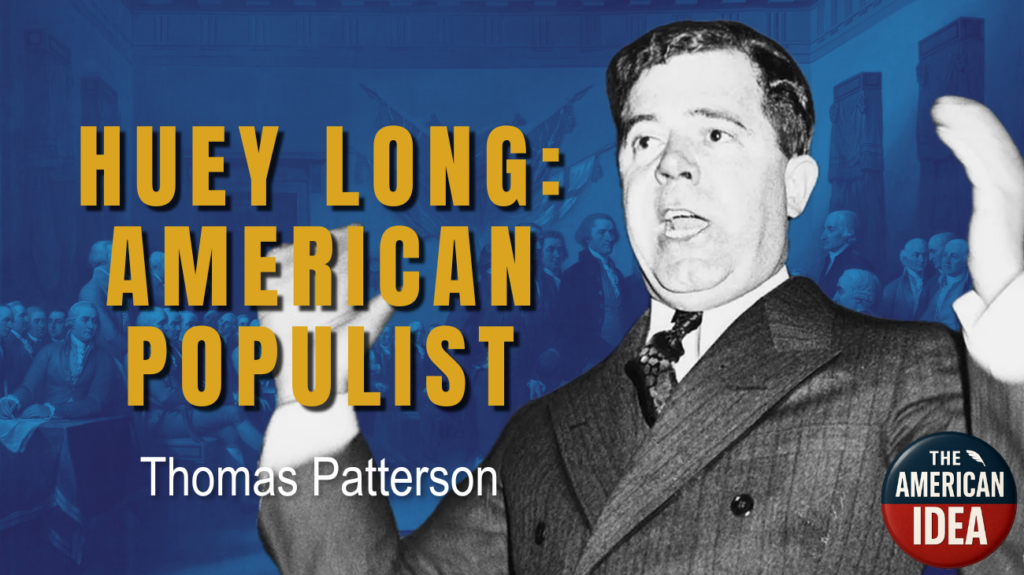
Huey Long: American Populist
January 28, 2026
Join The American Idea’s Listener Email list – get news about upcoming episodes and a chance to offer questions for them, too!
Few figures in American political history provoke such contradictory assessments as Huey Long. To his supporters, the Louisiana governor and U.S. Senator was a champion of the common man who took on entrenched wealth and power. To his detractors, he was a dangerous demagogue whose authoritarian methods threatened democratic governance. Nearly nine decades after his assassination, the debate continues, and Long’s ideas about wealth, inequality, and the proper role of government remain strikingly relevant.
The Making of a Populist
Long was born in 1893 in Winfield, a small town in northern Louisiana. The region’s soil, as one writer put it, “was too poor to grow much cotton, so Winfield’s primary crop was dissent.” This was Baptist country, small farmer country, a place so suspicious of concentrated wealth that it gave 36 percent of its vote to socialist Eugene Debs in 1912. At age 15, young Huey debated traveling Socialist lecturers and continued his discussions with them long into the night.
This environment shaped Long’s worldview. From his family, from the Bible read at the dinner table, and from historians he encountered, Long absorbed the conviction that concentrated wealth was an evil requiring remedy. Yet he was not alone in this thinking. Theodore Roosevelt had proposed limiting inheritances in 1906. Woodrow Wilson denounced privilege and concentrated wealth during his presidency. These Progressive ideas circulating nationally found especially fertile ground in the young man from Winfield.
Long left home at 16 without finishing high school and spent four years as a traveling salesman across the South. He then completed two semesters at Tulane Law School on a loan from his brother before studying independently and passing the bar at 21. Within his first year of practice, he led a campaign to reform Louisiana’s workers’ compensation laws, using techniques that modern scholars would recognize as classic social movement organizing: framing the issue, mobilizing support, and publicizing confrontations with the legislature.
Taking On the Powerful
Long won election to the Railroad Commission in 1918, a position that would prove consequential when Standard Oil and other major companies froze independent oil drillers out of the Pine Island oil field near Shreveport. Long championed legislation making pipelines common carriers, allowing small operators to ship their product without depending on the major companies’ infrastructure. He made lifelong enemies among Standard Oil’s personnel but established himself as a defender of small capitalists against industrial giants.
A landmark telephone rate case solidified his reputation. Fighting the case all the way to the U.S. Supreme Court, Long earned compliments from Chief Justice Taft as one of the most outstanding lawyers to appear before the bench. He won, then ordered the company to issue refunds to 80,000 Louisiana consumers. Overnight, Long became a state hero.
He ran for governor in 1924 and lost, partly because the Ku Klux Klan opposed him. His economic radicalism did not fit the conservative, “America first” ideology the Klan represented. He ran again in 1928, having carefully cultivated support among French Catholic voters in southern Louisiana, and won decisively.
The Governor Who Delivered
As governor, Long focused on three issues that affected virtually every Louisiana citizen: free school books for children, modern paved highways to replace gravel roads, and cheaper natural gas for New Orleans residents. These goals seemed modest, but their impact was profound. Free textbooks increased school enrollment by 20 percent. Night schools for adult illiterates substantially reduced illiteracy among both black and white residents. Thousands of miles of paved roads transformed transportation across one of America’s poorest states.
Long used patronage aggressively, hiring legislators to work in state agencies and rewarding their relatives with jobs. He made enemies among Louisiana’s old aristocratic elite, who resented this upstart from the northern parishes telling them what to do. “The legislature is like a deck of cards,” Long reportedly said, “and I can shuffle and deal as I please.”
His methods drew fierce opposition. In 1929, Long was impeached through what he described as a colorful set of circumstances, although he narrowly escaped removal. His opponents called him a dictator, a demagogue, and compared him to Lenin and Trotsky. Yet even critics later admitted that Long was right about many of his programs and that the mistake was opposing everything he proposed simply because he proposed it.
The Break with Roosevelt
Elected to the U.S. Senate in 1930, Long initially supported Franklin Roosevelt’s presidential candidacy and was among those who helped secure his nomination at the 1932 Democratic convention. But the alliance soured quickly. Long advocated taxing the wealthy and expanding relief spending during the Depression. Roosevelt, despite campaign rhetoric about redistribution, proposed deep cuts to government expenditures that devastated veterans’ benefits. Long opposed these cuts vocally, and Roosevelt responded by cutting off all his patronage.
The ideological divide deepened. Long wanted more aggressive public works, expanded money supply, and meaningful redistribution of wealth. Roosevelt manipulated and maneuvered but refused to deliver. By January 1935, Long broke completely, delivering radio speeches that swelled membership in his Share Our Wealth societies to 9 million people. Roosevelt’s own polling showed that Long, running as a third-party candidate, could tip the 1936 election to the Republicans. The president responded by increasing relief expenditures in states where Long posed the greatest threat.
Assassination and Legacy
Louisiana had a history of political violence stretching back through Reconstruction, and plots against Long were common knowledge. On September 10, 1935, Dr. Carl Austin Weiss shot Long in the Louisiana State Capitol. Weiss’s motives remain disputed: legislation gerrymandering his father-in-law out of a judgeship, broader fears of Long’s growing power, possibly rumors that Long planned to smear Weiss’s family. Long died two days later, likely a victim of medical malpractice in the hospital that treated him.
What remains of Long’s legacy? His critics point to his concentration of power, his manipulation of Louisiana’s political system, his willingness to bend or break rules to achieve his goals. These concerns deserve serious consideration.
But Long also proposed something that has no equivalent in American political history: a plan to preserve capitalism while remedying its tendency toward inequality. He advocated capping incomes and inheritances while providing minimum income and homestead guarantees for every family. This was not socialism, which would eliminate private ownership of the means of production. It was, as one historian described it, “capitalism with guardrails.”
Whether Long would have pursued this program responsibly, or whether his authoritarian tendencies would have overwhelmed his populist ideals, we cannot know. What we can say is that the questions he raised about concentrated wealth, economic power, and the obligations of government to ordinary citizens have not disappeared. Nearly 90 years after his death, Americans continue to grapple with inequality, with the political influence of great fortunes, and with the proper balance between free markets and social welfare; between the private sector and government power. Huey Long may have been a deeply flawed messenger, but the message he carried still demands consideration.
You can find Thomas Patterson’s book, “American Populist: Huey Long of Louisiana,” on Amazon.