
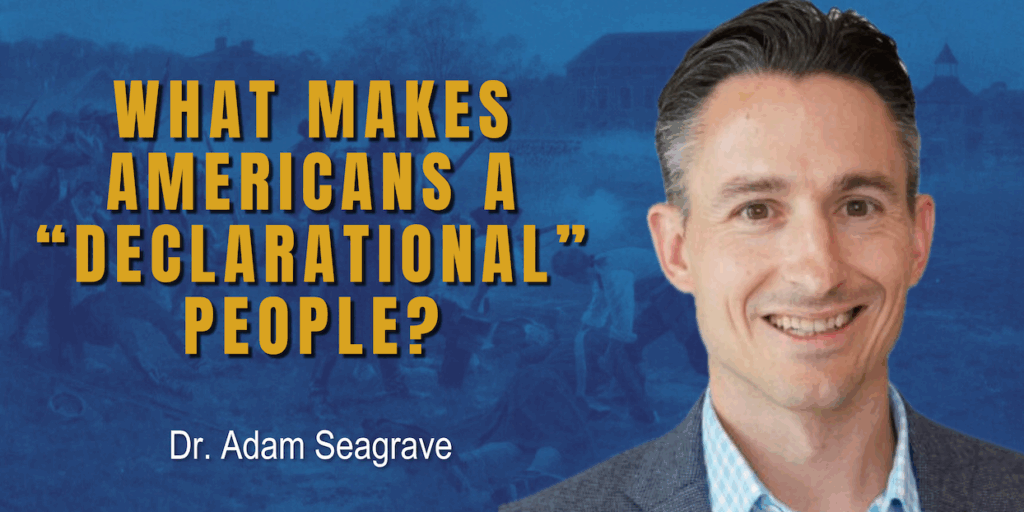
What Makes Americans a "Declarational" People?
January 14, 2026
Join The American Idea’s Listener Email list – get news about upcoming episodes and a chance to offer questions for them, too!
When most Americans think about the Declaration of Independence, they think about its famous second sentence: “We hold these truths to be self-evident, that all men are created equal, that they are endowed by their Creator with certain unalienable Rights.” These words have shaped political debates for nearly 250 years. They have been quoted by abolitionists, suffragists, civil rights leaders, and politicians of every stripe. The Declaration is, in many ways, America’s philosophical statement to the world.
But there is something curious about how the Declaration actually begins. Before any mention of self-evident truths or unalienable rights, the document speaks of “one people” dissolving the political bands that connected them to another. The Declaration does not simply announce a set of ideas. It announces the birth of a people united by a particular idea. This distinction matters more than we realize. If America is not just an idea but a people with an idea, then the character of that people becomes as important as the principles they profess.
The Three Virtues of a Declarational People
What kind of people does the Declaration envision? What habits of heart and mind does it require? One compelling answer points to three virtues that might seem surprising in a political context: faith, hope, and love.
Faith, in this sense, does not necessarily mean religious belief, though the Declaration is certainly a theistic document with its references to “Nature’s God” and the “Creator.” Rather, it means a willingness to take seriously moral principles that we cannot see or touch. The Declaration stands in sharp contrast to a purely Machiavellian view of politics, which cares only about power and material advantage. To embrace the Declaration’s vision, Americans must believe that ideas like equality and natural rights are real and binding, even when they are inconvenient. This requires a kind of faith in the unseen.
Hope, too, runs deeper than mere optimism. Abraham Lincoln understood this when he called the Declaration’s principles our “ancient faith” and treated them as aspirational truths. The founders who signed the document in 1776 knew they were not living up to its ideals. They understood that future generations would have to fulfill the promise more perfectly. Frederick Douglass captured this same spirit in his famous speech “What to the Slave is the Fourth of July?” Even while excoriating America for the evil of slavery, Douglass referred to the Declaration as containing “saving principles.” He believed, despite overwhelming evidence to the contrary in his own time, that the moral arc of the universe bent toward justice. This is not the shallow optimism of someone who ignores problems. It is a deeper hope grounded in conviction about the nature of things, and possibilities for the future.
Love might seem the strangest virtue to associate with politics. We do not typically expect citizens to love one another. But the Declaration’s vision of human dignity points toward something like civic friendship. If every person possesses inalienable rights and inherent worth, then we owe our fellow citizens a certain respect that goes beyond tolerating their opinions. This does not mean we have to like everyone or that we will never disagree. Factions and conflicts are inevitable in a free society, as James Madison recognized in Federalist No. 10. But beneath those disagreements, there can still be a recognition of the immense value of the person we are arguing with. Martin Luther King Jr. called this “agape love,” the love we owe to others simply because they are human beings created with dignity.
Civic Friendship and the Art of Disagreement
This vision of love has practical implications for how Americans engage in public life. We hear a lot today about the need for “civil discourse,” and rightly so. But civil discourse is often understood in superficial terms. We think it means listening politely to someone — before dismissing what they said. Or we think it means avoiding harsh language while still treating our opponents as enemies.
The Declaration points to something richer. True civil discourse means respecting the person who holds the opinion, not just the opinion itself. It means recognizing that even our political adversaries have dignity and worth. This disposition has the power to change how conversations unfold and how relationships develop over time. King’s leadership of the civil rights movement offers a powerful example. Part of his success came from the fact that people recognized he was pointing to a deeper vision of human dignity, even in the midst of intense conflict over policy. That vision made progress possible.
None of this eliminates faction or disagreement. A declarational people will still argue about taxes, immigration, foreign policy, and a thousand other issues. But they will argue as fellow citizens who share a fundamental commitment to one another’s worth. That is what civic friendship looks like in practice.
Why Shared Memory Matters
A people united by ideas must also be united by memory. If Americans do not share a common understanding of where they came from, it becomes very difficult to agree on where they should be going. Lincoln spoke of the “mystic chords of memory” that bind the nation together. When those chords are broken, civic friendship suffers, and with it, the people as a whole.
This is why debates over how we teach history matter so much. A declarational people needs to understand the Declaration itself, its origins, its meaning, and its legacy. But shared memory extends beyond a single document. It includes the stories of those who struggled to fulfill the Declaration’s promise, from Lincoln to Douglass to King. It includes honest reckoning with failures as well as celebration of achievements. Without this common inheritance, we cease to be one people in any meaningful sense.
The Declaration was also written with an eye toward the world. The first paragraph speaks of “a decent respect to the opinions of mankind.” From the beginning, America’s founding document has been outward-facing, inspiring revolutions and declarations of independence across the globe. This places a certain responsibility on Americans to embody the virtues they proclaim. The city on a hill, as John Winthrop put it, is always being watched.
Grounds for Hope
Is there reason to be hopeful about America’s future as a declarational people? The honest answer is that our current political culture does not offer much immediate encouragement. Polarization runs deep. Social media amplifies bitterness, and creates echo chambers. Trust in institutions has declined.
And yet there are signs of renewal. Interest in civic education has grown in recent years. Teachers across the country are working to help students understand America’s founding principles and history. These efforts may not make headlines, but they plant seeds that can bear fruit over time.
Perhaps that is the final lesson of being a declarational people. Hope is not the same as optimism. It does not depend on favorable circumstances. It rests on faith that the principles announced in 1776 remain true and that a people committed to those principles can still find their way forward. As America approaches its 250th anniversary, that hope is worth holding onto.
If you’re interested in learning more about America’s Founding principles, and how they have been understood over time, tested by crises, and challenged in debates, consider signing up for The American Idea online class, free from the Ashbrook Center. This self-paced course will help you understand three essential documents in our history: the Declaration of Independence, Lincoln’s Gettysburg Address, and Dr. Martin Luther King Jr.’s “I Have a Dream” speech, and how, despite being separated by time and circumstance, all point to the same set of foundational ideas.