
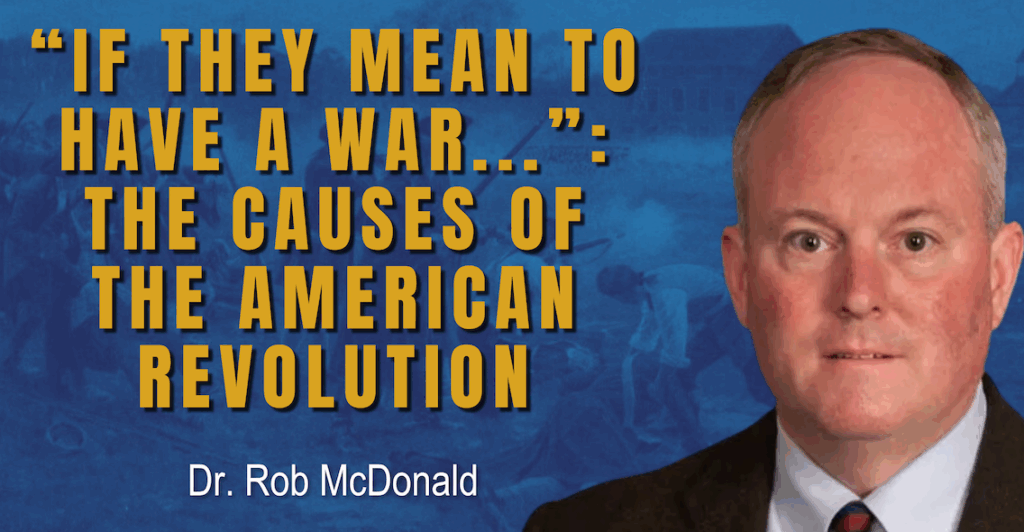
"If They Mean to Have a War..." - What Caused the American Revolution?
December 3, 2025
Join The American Idea’s Listener Email list – get news about upcoming episodes and a chance to offer questions for them, too!
The American Revolution contains a paradox at its heart: no subjects of King George III were more devoted to British principles than the colonists in North America. They treasured the ideals of the Glorious Revolution of 1688, which had limited royal power and secured the rights of subjects. Yet this very commitment would drive them to rebellion. Americans believed they were defending authentic liberties while their cousins across the Atlantic had abandoned them.
After the French and Indian War ended in 1763, few imagined independence was coming. The war had been a shared triumph, expelling French power from the colonies, but Britain’s national debt had doubled as a result of the war. Parliament sought new revenues and turned to enforcing long-neglected trade regulations in America, where smuggling flourished.
The First Cracks
The crisis began in 1761 with writs of assistance, which would grant British officials sweeping powers to search homes, barns, and ships without specific warrants. James Otis challenged them by invoking an ancient principle: every person’s house is their castle. If you rule your own castle, then the king does not. This expressed a fundamental boundary between government authority and private life that the writs threatened to erase.
The Stamp Act of 1765 sharpened the conflict by imposing taxes on paper goods without colonial consent and denying accused violators jury trials. If Parliament could seize colonial property and strip away trial by peers, what rights remained? The colonists drew their political philosophy from John Locke and the Glorious Revolution, which held that government exists to protect natural rights to life, liberty, and property. Parliament’s actions seemed to violate these first principles directly.
Colonial resistance forced Parliament to repeal the Stamp Act in 1766, but simultaneously it passed the Declaratory Act, asserting authority to govern the colonies “in all cases whatsoever.” This created an unbridgeable gap. Colonists acknowledged Parliament’s power over foreign policy and imperial trade, yet insisted that only their own legislatures could tax them or manage internal affairs. These assemblies had governed locally since 1619 in Virginia, making self-government an old, established practice rather than a new demand.
Occupation and Violence
Britain made a catastrophic mistake in 1768 by sending 4,000 troops to Boston, a city of just 16,000 people. One in five Bostonians now wore a red coat. The French were gone, and no Native American threat loomed. Americans understood the purpose of these troops; they existed solely to intimidate.
The inevitable confrontation came on March 5, 1770, when a British sentry faced an angry crowd hurling snowballs, sticks, and stones. Reinforcements rushed to his aid as church bells rang, signaling emergency. In the confusion, shots rang out, leaving eleven colonists bleeding on the ground. Five would die.
The Boston Massacre convinced many that Britain now threatened their lives, not merely their property or liberty. Interestingly, John Adams defended the soldiers in court and won acquittal for most, demonstrating that American justice still functioned fairly under intense political pressure. This should have reassured Britain that colonists remained capable of self-government, yet tensions continued to escalate.
The Breaking Point
By 1773, Boston had become a tinderbox. When ships carrying taxed tea arrived, residents refused to let them unload. Rather than allow British seizure of the cargo, men disguised as Mohawks dumped 90,000 pounds into the harbor, destroying only the tea and broken locks, which they ceremonially replaced the next day.
Britain’s response exceeded all reasonable bounds. The Coercive Acts shut down Boston Harbor, imposed martial law, and banned the legislature from meeting except to discuss repayment. Town meetings became illegal overnight.
The implications rippled beyond Massachusetts. When Virginia’s House of Burgesses supported Massachusetts, the royal governor disbanded the assembly, attempting to destroy several generations of self-government by fiat. The legislators simply reconvened as the Virginia Convention. Yet Britain refused to recognize these bodies or the Continental Congress formed in 1774, leaving force as the only remaining means of resolution.
Resistance Becomes Revolution
British troops marched toward Concord before dawn on April 19, 1775, ordered to seize colonial weapons. The mission was secret, but riders spread the alarm. At Lexington, local militia assembled as dawn broke. Captain John Parker gave careful instructions: “Don’t fire unless fired upon, but if they mean to have a war, let it begin here.”
Most Americans still thought in terms of resistance rather than revolution. They wanted to defend their rights and force British respect through resolve. Many hoped their willingness to fight would shock Parliament into reversing course. As late as 1775, the Continental Congress petitioned King George III directly, hoping he might restrain Parliament. The king refused to receive it.
By December 1775, Britain declared the colonies outside its protection and authorized military action. Following John Locke’s reasoning, colonists questioned whether Britain still functioned as legitimate government. Government should protect rights, yet Britain had disbanded legislatures, imposed martial law, and waged war on its subjects. It resembled less a government than a hostile force wielding power through violence.
The Republican Turn
Thomas Paine’s “Common Sense,” published in early 1776, crystallized these sentiments while adding something radical. Beyond condemning Britain’s heavy-handed actions in the colonies, Paine attacked monarchy itself, noting that the British monarchy began when a French invader imposed his rule by force. Why defer to someone based on hereditary accident?
When a unified call for independence came in July 1776, Americans embraced republicanism rather than replacing one king with another. This was startling given that monarchy dominated the world and successful republics were rare. Yet Paine had stripped monarchy of legitimacy, and America lacked the aristocracy from which to draw a royal line. Instead, Americans charted a new course, based on their own traditions of consent-based self-government and the ideas set forth by a number of Enlightenment thinkers, John Locke central among them.
Thus, what started as defense of traditional British liberties became a revolution in political thought. The colonists believed they were true heirs of the Glorious Revolution. By 1776, they concluded that preserving those principles required abandoning monarchy and attempting republican self-government. Britain and America could have been a great people together. But Parliament’s determination to assert unlimited authority without consent, combined with refusal to recognize the constitutional claims of its own subjects, made reconciliation impossible. The most loyal British subjects became revolutionaries not because they rejected British principles, but because they insisted on them. That insistence, met with force, produced a new nation and launched an experiment in human freedom that would reshape the political world.