
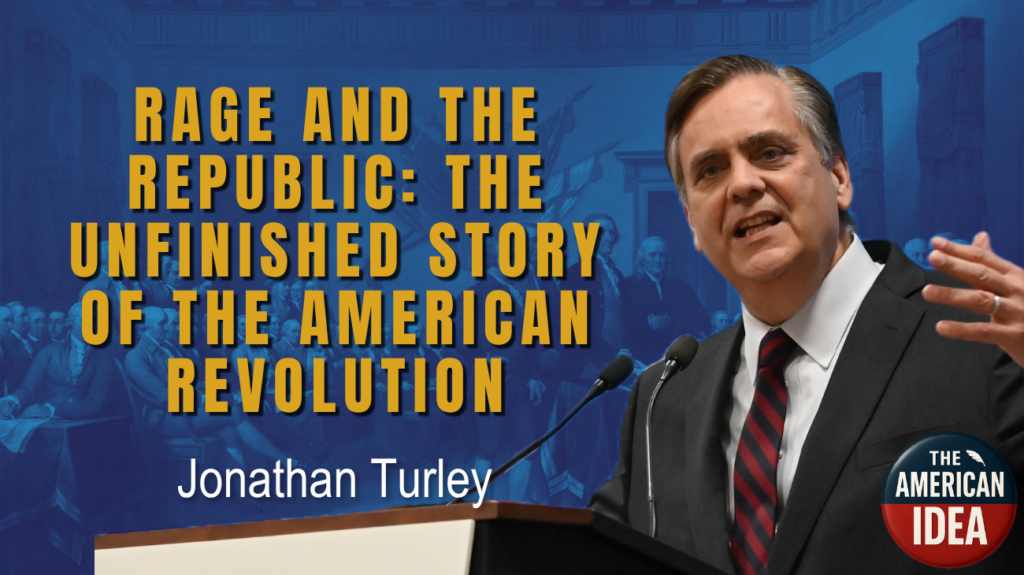
Rage and the Republic: The Unfinished Story of the American Revolution
September 30, 2026
A Frenchman watching his own revolution consume itself in 1793 left behind a line that has outlived nearly everything else written that year: like Saturn, the revolution devours its children. He was not speaking metaphorically. The men who had drafted France’s founding documents were, one after another, climbing the scaffold at the order of men who had stood beside them a season earlier.
That line is the right starting point for thinking about the American founding at 250 years, because it names the problem the founders actually faced. The interesting question about revolutions is not how they begin. Grievance is cheap and plentiful, and history has never lacked for people willing to tear something down. The interesting question is how revolutions end. Most end badly. They end in exhaustion, in the return of the old order under a new name, or in the arrival of a strongman who promises order and delivers it at a price. The American Revolution ended in a constitution that still governs, which makes it close to unique.
The founders knew the odds. They studied the Athenian democracy that academics have celebrated ever since, and they were not impressed. Athens lasted a relatively short time, decayed into what they called mobocracy, and finished under tyranny. Benjamin Rush and others spoke openly about designing a democratic system that would not follow that path. They were not building on a model. They were building against one.
The Failure Who Wrote the Revolution
The story of how America escaped that fate runs, improbably, through a man the founders themselves found difficult to like.
Thomas Paine arrived in the colonies in 1774, two years before the pamphlet that made him the penman of the Revolution. He arrived having failed at everything. He had been dismissed from every job he held. Every business he started collapsed into bankruptcy. Both of his marriages ended in grief. He was penniless and friendless in London when he stood in front of Benjamin Franklin, who had an unusual gift for recognizing talent in unpromising packaging, and who looked at that human wreckage and saw something worth funding. Franklin paid Paine’s passage across the Atlantic and told him to write.
What Paine wrote was Common Sense, published anonymously and consumed across the colonies at a speed nothing in print had achieved before. Speculation about the author ran in every direction. Abigail Adams wrote to her husband that people were attributing it to him. John Adams, who would later become one of Paine’s sharpest critics, wrote back that he could not have written it, but that he thought he knew who had. He had met a man named Paine, and the man had genius in his eyes.
Paine has been shuffled to the margins of the founding story, partly because he never fit the company he kept. He was self-educated where they were classically trained. He was vehemently opposed to slavery in a room full of men who were not. He was, by every account including friendly ones, difficult. He may also have been the most genuinely American figure of the entire generation, a man who came to the continent to pursue what he sensed was possible here and who later wrote that there was a happy something in America. He even added an e to the end of his name. He arrived as one thing and became another.
He was also one of only two men, Lafayette being the other, to play a significant role in both the American and French revolutions. That gave him something no one else had: firsthand experience of both outcomes.
What Paine Saw in Paris
The Jacobins wanted things that should sound familiar. They wanted a unicameral legislature, unchecked by a second chamber. They dismantled the court system. They attacked the wealthy as a class. Above all they wanted direct democracy, the unmediated expression of popular will, because they had absorbed Rousseau’s conviction that human beings are naturally good and that a people left to govern themselves will produce a general will and a decent society.
The conviction was naive, and the naivety was lethal. What emerged from it was Robespierre, who concluded that terror is virtue. The machinery worked outward in widening circles. The Jacobins killed the aristocracy, then the clergy, then one another. Robespierre’s faction moved against the Girondins, the moderate wing with which Paine was associated.
Paine was at an inn outside Paris with the last seven of his surviving friends when the knocks began. One by one they were taken and guillotined. Eventually the innkeeper was taken, leaving Paine alone. Then the knock came for him. An hour earlier he had finished a manuscript, and he carried it with him into the Luxembourg Palace prison. It was The Rights of Man.
It was in that cell, not in Philadelphia, that Paine finally understood what James Madison had meant by auxiliary precautions. A system that channels passion is not a betrayal of popular government. It is the only thing that lets popular government survive contact with actual human beings.
Here is the heart of it. America needed both men and could not have done with either alone. Paine understood what it takes to move a people to revolution: righteous rage, the voice that galvanizes. Madison understood what it takes to move a revolution to a republic: patient structure, the pious logic of design. Rage without structure produces the Terror. Structure without rage produces nothing at all.
Madison’s architecture was Newtonian. He conceived the three branches as planets held in orbit by their mutual gravitational pull, stable precisely because they strain against one another. The tension is the mechanism, not a flaw in it. Factional pressure gets directed inward toward the legislature, where competing interests are forced to grind themselves into a single majoritarian compromise. France built no such chamber and had nowhere for pressure to go except into the streets.
Federalism serves the same function on a different axis. Rights are most secure when they are held closest, which is why so much decision-making was meant to stay local. As the center of government recedes from the citizen, something quietly corrodes. People stop believing their participation changes anything, and shortly afterward they stop believing in the government itself.
Whether the Bill Comes Due
At 250 years, a crisis of faith has arrived on schedule. Law professors and deans now publish books arguing that the Constitution should be discarded, that no constitution lasts forever. It is worth noticing that the Jacobins were not the proletariat either. They were intellectuals, journalists, lawyers, and professors. Robespierre was an attorney. The demands circulating today, a single chamber, an abolished Supreme Court, more direct democracy, are lifted intact from that playbook.
The more serious pressure is economic. This is also the 250th year of The Wealth of Nations, and the timing is not incidental. Adam Smith found his first enthusiastic audience not in Europe but here, because the founders recognized immediately that his economic theory was the necessary companion to their political theory. They believed there is no path to liberty for people who are economically dependent, particularly dependent on government. That is what they loved about agrarian life, not its pastoral charm but the plain fact that you could put something in the ground and independence would grow out of it.
Artificial intelligence and robotics will test that premise hard. Even conservative estimates point to substantial job loss, and while a new economy will eventually generate new work, the burn-off period will be long and the new jobs will tend to go to younger entrants. Millions may find themselves not merely unemployed but unemployable. The temptation will be to solve this by simply paying people, and the danger is not economic but civic. A republic of kept citizens is not a republic. The founders designed this system for a particular kind of person, and that person is not a recipient.
Tocqueville described a science of living freely. The founders discovered an art of it, built on the enlightenment principle that rights come not from government but from God, that they belong to us as human beings rather than as privileges granted and therefore revocable. This generation will have to refight that argument.
It was Crèvecoeur, a Frenchman who farmed here and then went home to write about it, who asked the question that still sits unanswered: what then is this American? Europe could not understand how a people with nothing in common, no shared land, no ancient institutions, no inherited class structure, had produced the first enlightenment revolution. The question was profound then and it is more urgent now. If we cannot answer it, the anniversary loses its meaning.
But the honest diagnosis is not a pessimistic one. Madison is routinely read as a cynic who thought little of human nature, and the reading gets him exactly backward. He was the most optimistic writer of his generation precisely because he accepted us as we are. He did not find our factionalism obnoxious or our self-interest beneath notice. He looked at people clearly, declined to imagine them as angels, and still concluded that together they were capable of something magnificent. That is a far sturdier foundation than Rousseau’s, and it has held for 250 years. The only real danger is a self-inflicted one: discarding the system that has carried us this far, at the exact moment it is needed most.
Read Jonathan Turley’s new book, Rage and the Republic.