
Fact or Fiction? Historians Discuss Young Washington
August 19, 2026
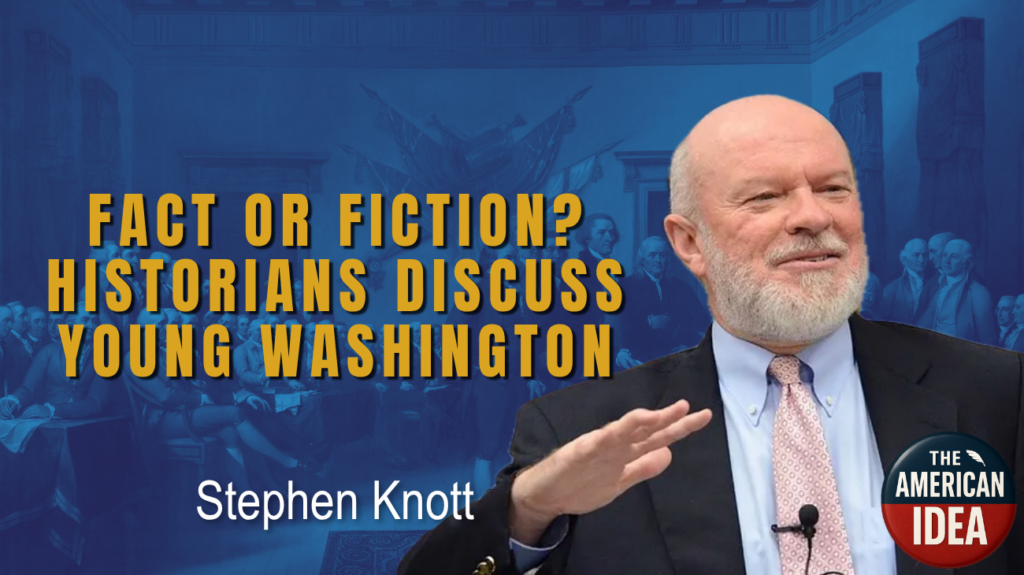
Every filmmaker who takes on a founder inherits a problem no historian has to solve. A biography can run six hundred pages and still apologize for what it left out. A film has barely two hours, creating a zero-sum challenge of accuracy versus story. Compressing even a slice of George Washington’s life into that window forces choices, and Young Washington makes them openly. The film’s director told the historians reviewing the script up front that concessions would be made, that the picture would not be accurate down to who died when or which cannons appeared at which engagement.
That candor is worth more than it might seem. Historical film has a habit of claiming fidelity it never intended to deliver, and audiences absorb the claim along with the story. The more useful standard comes from a line the production borrowed from screenwriter Aaron Sorkin: a biographical film should not attempt a photograph but should paint a portrait. The comparison holds. An impressionist canvas gets the details demonstrably wrong and still captures something a photograph would miss.
Unfortunately, most Americans learn their national history from the screen rather than from a textbook or the founding documents themselves, which means a distorted film does lasting damage to how citizens understand their own country. Oliver Stone’s JFK remains the cautionary case, a string of fabrications that permanently shaped public belief about the Kennedy assassination. Young Washington is a different kind of production. Its inventions are decorative rather than structural, and the character it builds is recognizable as the man the documents describe.
An Ambitious Young Man on the Edge of the Aristocracy
The film’s most historically grounded thread is Washington’s hunger for a royal commission. He wants desperately to be a commissioned officer in His Majesty’s forces, and British officers in Virginia inform him bluntly that no such path exists for a colonial. That goal was real, and it makes sense only against the social geography of tidewater Virginia, where Washington sat on the edge of the aristocracy rather than securely inside it.
The gap between a British regular and a colonial militiaman was not administrative. British officers trained at elite academies, carried better equipment, and held a settled conviction of their own superiority. Militia were treated as second-class troops, unfairly but consistently. Washington’s ambition was enormous, and the summit he could see was the British army, not the Virginia militia.
That same hierarchy produced a costly blindness. British commanders were reluctant to learn from men who knew the backcountry and understood how their Native adversaries fought. The film gives this failure to General Braddock, who waves away warnings about roads that do not exist and distances that cannot be covered on schedule. The pattern outlasted him. In 1777, General Burgoyne moved a caravan miles long down trails no wider than a horse toward Albany and bogged down in the woods, a delay that helped hand the Americans their decisive victory at Saratoga. The British were slow to grasp that war in North America was nothing like war on the plains of Europe.
There is a risk in dwelling on British contempt, and the film comes close to it. Focus too much on the insults and Washington’s later break with the crown starts to look like revenge for wounded pride rather than a considered political act. Washington’s motives are genuinely harder to reconstruct than Jefferson’s or Madison’s, because he was a man of action rather than a systematic writer. The evidence of his thinking exists, but it takes work to find.
The Reader Behind the Soldier
That difficulty produced a durable caricature: Washington as the least intellectual founder, a figurehead who needed sharper minds to supply his ideas. Scholarship has been steadily dismantling this flawed view. Kevin Hayes’s George Washington: A Life in Books works through the contents of Washington’s library and the notations he left in the margins of his many books, and what emerges is a serious reader rather than a borrower of other men’s conclusions.
The film picks up the same thread, showing a young man badly disappointed at losing his formal education when his father died and then hunting down books and recommendations on his own. The portrayal is accurate, and it matters for how the rest of Washington’s career reads. He was not managed by Alexander Hamilton during his presidency, as an older interpretation of the administration held. He was heavily involved in policymaking, for better and worse, and he was nobody’s puppet. He may not have belonged in the same intellectual league as Madison, Jefferson, or Hamilton, but he was no slouch.
Fort Necessity and the Uses of Failure
The center of the film is Fort Necessity, and it is not a triumph. Washington is dispatched on a mission of real consequence, a French officer ends up dead under murky circumstances that helped ignite a global war, and Washington throws up a makeshift fort in a location he has been warned is indefensible. He refuses to move. He is beaten.
This portrayal is fair. Washington could be rigid to the point of brittleness, and the trait persisted. Late in the Revolution his generals had to talk him out of a frontal assault on the British headquarters in New York, a plan they considered close to suicidal, before the army moved south and trapped Cornwallis at Yorktown. Yet the same rigidity was a strength. It is hard to imagine another man absorbing eight years of foot-dragging from the Confederation Congress and the state governors over men, weapons, and food. The Revolution is difficult to picture succeeding without that stubbornness.
Two of the film’s inventions serve this theme. Christopher Gist does not die at Fort Necessity in the historical record; he died of illness roughly five years later. Sally Cary was already married to William Fairfax by the time the film has Washington pursuing her. Both are fiction, and the second is the more defensible: a story about a young man who fails and keeps going needs him to fail in love as well as in war.
Which leaves the objection that greets nearly every film of this kind, that it is one more celebration of a dead white slave owner. The flaws are not in dispute. But these men launched a project that remains unfinished, and their writings still speak to Americans working on it in 2026. Hamilton, whatever its errors, sent a generation of young people looking for the early republic who had arrived knowing nothing about it. That is an argument for more films of this kind, not fewer.