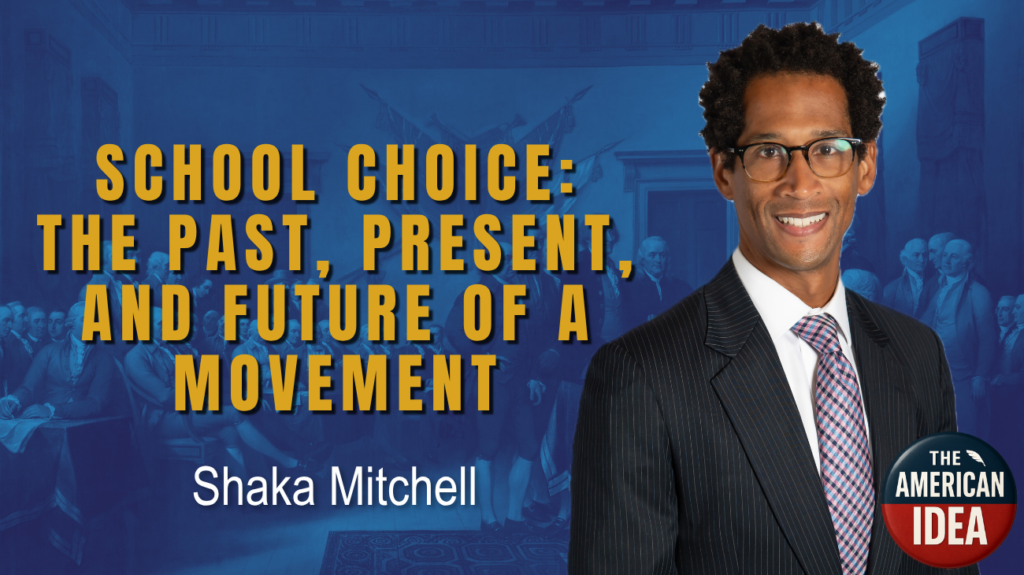
School Choice: The Past, Present, and Future of a Movement
May 20, 2026
Most debates about school choice treat it as a recent invention, a policy experiment born sometime in the 1990s amid arguments over vouchers and charter schools. That framing misses roughly three centuries of American history. The idea that families should have meaningful say over how and where their children are educated is not new. What is new is the scale at which that idea is now being put into practice.
Understanding where the school choice movement came from, and why it has gained the momentum it has, requires going back further than most people expect.
Before Public Schools, There Was Already Choice
Education in colonial America was decentralized by necessity. There was no Department of Education, no standardized curriculum, and no expectation that government would organize schooling for the population at large. Communities, particularly in the Northeast, pooled resources to provide children with at least basic instruction. Towns often funded a range of options, including schools with religious affiliations, because that reflected what families wanted. The choice, in other words, was there from the beginning.
That began to change in the 1800s. Horace Mann, often credited as the father of the American public school movement, was a reformer who sought to guarantee education for all. The historical reputation is partly deserved. But Mann’s vision deserves closer scrutiny than it usually receives. He once wrote that educators “are entitled to look upon all parents as having given hostages to our cause.” That is not the language of a reformer putting families at the center of education. It is the language of an administrator who viewed parents as subordinate to institutional authority. The tension between those two visions — family-directed education versus institution-directed education — runs through every major school choice debate that has followed.
Religious Liberty and the Courts
As public schools expanded through the late 19th and early 20th centuries, private and religious schools came under increasing pressure. Much of that pressure was not philosophically neutral. A wave of anti-Catholic sentiment, directed at the flood of European immigrants, produced what are known as the Blaine Amendments — laws passed in nearly 40 states that prohibited public funds from going to religious schools. The stated rationale involved separation of church and state. The actual target was the Catholic Church. Protestant-dominated public institutions were not treated with the same suspicion.
The Supreme Court eventually drew a firm line. In Pierce v. Society of Sisters, the Court rejected Oregon’s attempt to compel all children to attend public schools, affirming that parents hold primary authority over the education of their children. Children, the Court held, are not creatures of the state. That principle has not been overturned. Justice Amy Coney Barrett cited Pierce as recently as a few years ago, applying its language to a current case out of the Ninth Circuit. The foundation laid in the 1920s is still holding.
From Desegregation to Market Reform
For several decades after Pierce, the most pressing education questions in America had less to do with school choice and more to do with racial justice. The battle over desegregation consumed the courts and the country from the 1930s through the 1970s. Brown v. Board of Education was a landmark, but integration alone did not resolve the problem. By the late 1980s, many schools were technically integrated and still failing their students. Reading scores were poor. Math scores were poor. The students bearing the heaviest burden were disproportionately low-income and Black.
Into that gap stepped economists Milton and Rose Friedman, who had been arguing since the 1950s that the problem with American education was structural. Public dollars and public provision had been bundled together as though they were inseparable, but there was no inherent reason why government funding of education required government operation of schools. What if the money followed the child instead of the institution? What if market competition, rather than bureaucratic management, drove improvement?
Those ideas found their first real-world test in Milwaukee.
Milwaukee and the Birth of the Modern Movement
In 1990, an unlikely coalition came together in Wisconsin. Republican Governor Tommy Thompson, African-American Democratic state representative Polly Williams, and Dr. Howard Fuller — a former pan-African nationalist who had opened his own private school before becoming superintendent of Milwaukee Public Schools — united around a single argument: the existing system was failing children, and something different had to be tried. The result was the Milwaukee Parental Choice Program, the first private school voucher program in the United States. It is still operating today.
The program faced immediate headwinds. Parents who had never had options had to be educated about what options now existed. Private schools, caught off guard by the demand, did not have enough seats. Teachers unions, school boards, and administrators’ associations pushed back hard, deploying significant lobbying resources against a movement that, as one observer noted, had no lobbyist on the other side. Parents rarely do.
The legal questions took more than a decade to settle. In 2002, the Supreme Court ruled in Zelman v. Simmons-Harris that voucher programs used at religious schools do not violate the First Amendment’s Establishment Clause. The key reasoning: it is parents, not the government, who direct where the funds go. That intermediate step breaks the chain between state and church. The Court compared it to a family using food assistance to buy kosher groceries: the state is not endorsing a religion, it is enabling a choice.
A New Era, Accelerated by a Pandemic
COVID-19 did not create the school choice movement, but it compressed a decade of change into a few years. When schools closed and remote learning exposed the rigidity and in many cases questionable content and quality of traditional systems, millions of families concluded they could do better. Parent frustration, long simmering, boiled over and became political energy.
The result is an era of Education Savings Accounts — or, more accurately, education spending accounts — that allow families to direct a portion of public per-pupil funding toward tuition, tutoring, curriculum, or specialist services, depending on what each child needs. Texas launched its Education Freedom Scholarships program recently, drawing 220,000 applicants for 100,000 available slots.
Thirty-two states and the District of Columbia now have some form of private school choice program. Seventeen of those programs are universal, available to all children regardless of income. Classical schools, Montessori programs, hybrid homeschool arrangements, and microschools are growing alongside more traditional private and charter options. The school choice ecosystem has become genuinely pluralist, which is precisely what its proponents argued it should be.
Whether public school districts can adapt to this new landscape is the open question. The ones likely to survive, and to continue serving students well, are those willing to think of themselves as education service providers competing on quality, rather than institutions entitled to enrollment by geography. The ones that cannot make that shift face a long decline. Either way, the movement that started in Milwaukee more than three decades ago is not reversing course.